Entry signal price pattern
You'll learn
- How to wait for the full break, close an retest before looking for entry setup pattern candles.
- How to identify and analyse three entry setup candle patterns:
- Pin-bar or Pin-candle
- Engulfing Candle
- Tweezers
- How to develop discipline and patience and wait for one of the three setup candle patterns to appear before considering entering a trade.
- How to overcome challenges such as learning to trust the system and controlling the impulse to enter trades early.
- How to manage frustrations when a trade doesn't work out despite following the rules, and staying calm when a trade reaches its target without presenting a valid entry.
Why should you learn this ?
Entry is the 2nd most important element of a trade (exit is the most important).
The financial markets can be volatile and unpredictable. By having well-defined entry signals, you can rely on objective criteria rather than emotions or hunches when initiating trades.
Other areas of benefit include:
- Better risk management
- Increased probability of success
- Consistency and Reproducible trades
- Avoiding over-trading
What happens if you don't learn this
Without suing clear entry signals, you are more likely to make impulsive decisions based on emotions such as fear, greed and or anxiety. Emotional trading can lead to erratic and inconsistent trading patterns, resulting in poor overall performance.
Also:
- Increased risk
- Lack of discipline leading to inconsistency of results
- Missed opportunities or over-trading
What it will be like, once you master this
You'll be a master of trade entry decision making.
You'll read and understand clearly the entry signals, and therefore make informed and objective decisions.
You will be able to identify high-probability trade entry levels with greater accuracy, based on well-defined criteria and reliable market indicators.
This will lead to better entry timing and enhances the overall quality of trades.
Glossary
- Pinbar (Pincandle): Characterised by a small body and a long protruding tail or shadow.
- Engulfer (Engulfing Candle): Consists of two consecutive candles. The second candle is larger and completely engulfs the entire body and one wick for of the first candle, hence the name, "engulfing" candle.
- In Forex it's impossible for a candle to completely engulf the entire previous candle, but it is possible in stocks
- Our engulfer only has to engulf one of the two wicks; the one in direction of travel (top for bullish, bottom for bearish).
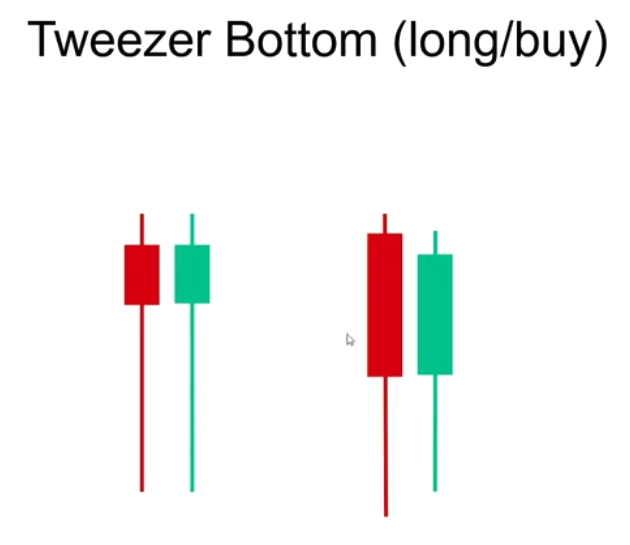
- Tweezer Candles: Two consecutive long wicked candles together.
Important!
Don't look for the entry until after the break, close, retest!
Patterns
Pinbar
- Small body: < 50% of the candle. The body represents a narrow price range between the opening and closing prices.
- Bullish: Part of its body must be in the top 25% of the overall length of the candle.
- Bearish: Part of its body must be in the bottom 25% of the overall length of the candle.
- Long tail or wick: Long tail/wick - for long/buy signals, the bottom 50%+ of the candle should be wick. For short/sell candles, the top >= 50% of the candle should be wick. The tail represents the price range between the high or low and the closing or opening price, respectively.
- Small or Non existent, opposite wick: If the top wick is big; the lower wick should be small to non-existent, and vice-versa. This indicates that the price did not move significantly beyond the opening or closing level.
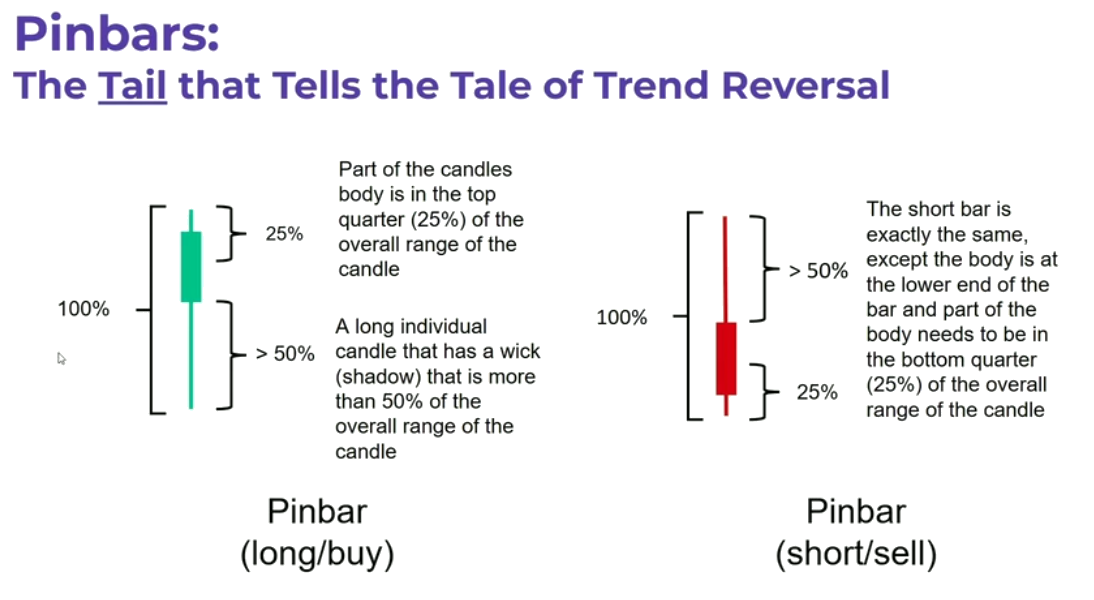
If a pinbar is a pivot point, it's extra strong. eg. for a bearish pinbar, its high should be higher than its neighbour's on both sides.
Engulfers
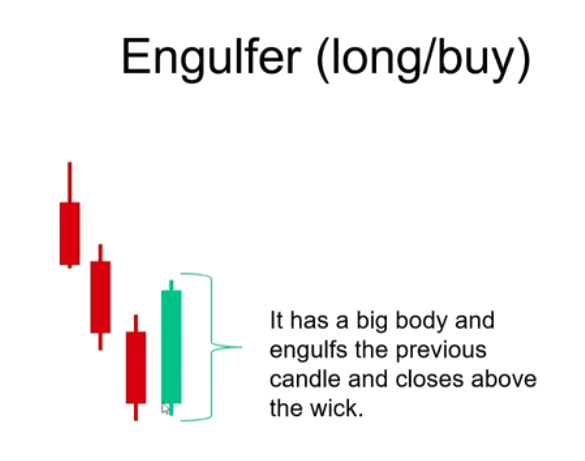
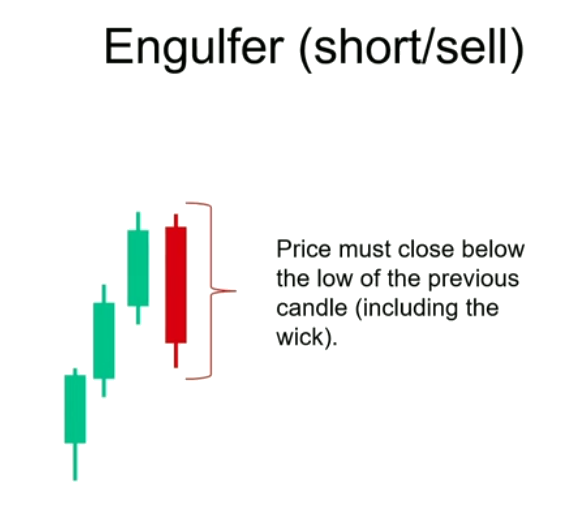
An engulfing candle completely engulfs the preceding candle's body and wick in the direction of travel so that it closes above (for bullish), or below (for bearish) the whole of the preceding candle.
- A bullish engulfer
- Open <= previous close
- close > previous high
- The close must be >= 75% of the entire candle height
- Follows a red candle
- Is a green candle
- A bearish engulfer
- open >= previous close
- close < previous low
- The close must be <= 25% of the entire candle height
- Follows a green candle
- Is a red candle
Floating engulfer
Same as a normal engulfer, but follows a candle of the same colour
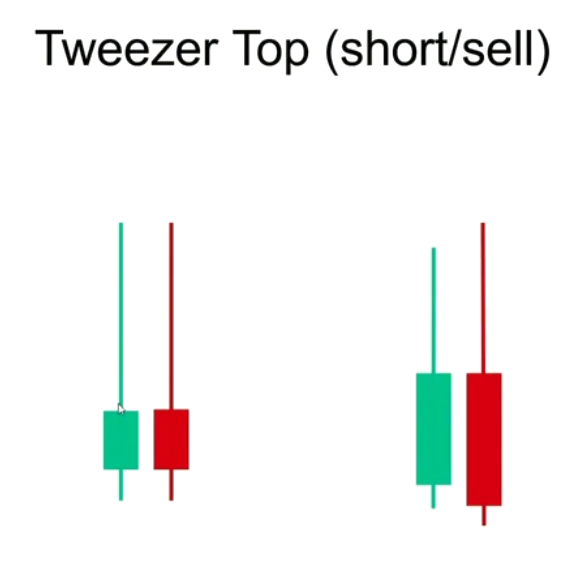
Tweezer Candles
When 2 pin candles appear next to each other it looks like a pair of tweezers.
Unlike normal tweezer candles, where the wick must be >= 50% of the candle, they only have to be >= 35%.
They should have similar highs and lows.
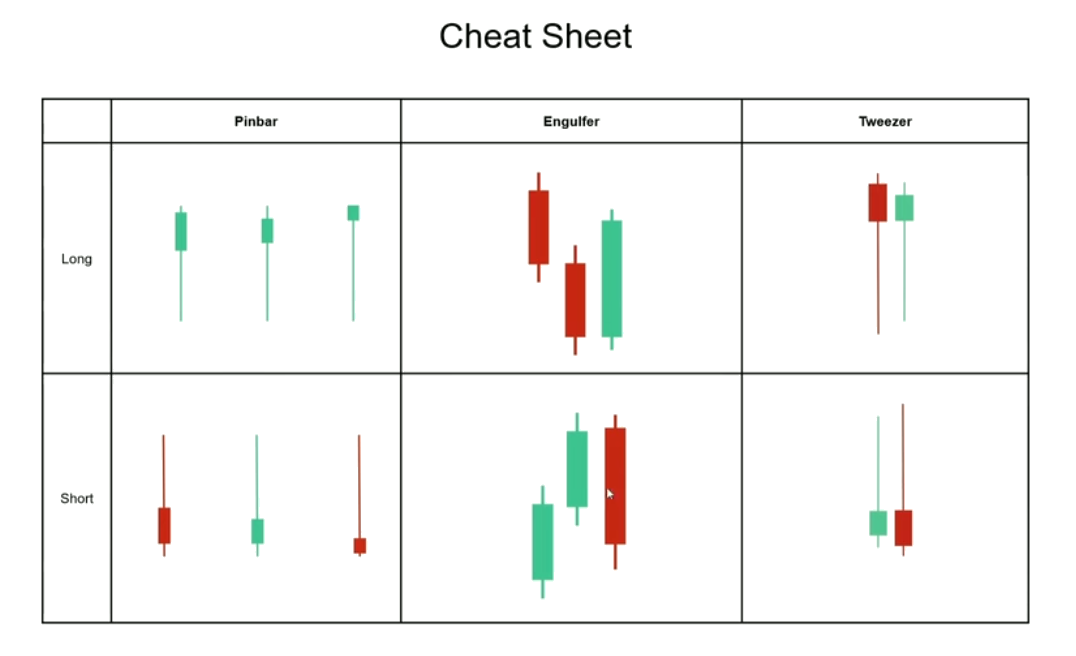
Cheat sheet
Invalidating candles
- For a bullish reversal signal, if price closes below it, it is invalidated.
- For a bearish reversal signal, if price closes above it, it is invalidated.
Challenges
- You may struggle with patience and timing, having to resist the temptation to enter trades prematurely or chase the market.
- You may come across false signals, where not every candle pattern will result in a successful trade.
- You may struggle with interpreting candle patterns.
- You may experience the impact fo market volatility, which can reduce the reliability and effectiveness of entry candle patterns due to erratic price movements and increased noise.
- You may encounter missed opportunities by waiting for a specific entry candle pattern.
- You may get FOMO or doubt in your analysis.
Signs if you do it wrong
- You enter trades before valid entry setup candles appear.
- You will be unsure of what a valid entry setup looks like and not know if y ou have entered a trade correctly.
- You will be frustrated and doubt the system, when a trade does not go to target, despite following the rules for entry.
- You will be impatient and frustrated waiting for the full setup to appear
- You will be doubly frustrated when the pattern completes and goes to PCL without giving a valid entry candle pattern.
How to overcome the challenges
- Focus on following the rules diligently
- Practice, and continuously backtest to improve your pattern recognition skills.
- Back-testing is particularly useful when comparing waiting for a high probability entry signal and entering arbitrarily.
- keep a trade journal to track the effectiveness of different entry candle patterns. This provides valuable insights for future trades. For example pin candles may work better in some markets than others. Generally tweezers work everywhere. But you'll see this for yourself when you go through your journal.
As you practice, remember:
- Motivation can fluctuate, and it's normal to expedience periods of lower motivation.
- Practice the strategies you're learning and remain positive.
- Have a long-term vision. Remember the potential rewards and benefits of trading.
- Break goals down into achievable steps, focusing on smaller tasks for a sense of progress and motivation.
- Seek support from fellow traders for encouragement and fresh perspectives. (Use the community and legacy student hangout room).
- Celebrate milestones: and progress along the way, regardless of their size - we want to see your posts
- Prioritise continuous learning and improvement with a growth mindset.
- Reflect on past successes to boost confidence and remind yourself of your capabilities
- Focus on the trading process, not just the results, to stay motivated and develop skills.
- Take breaks and practice self-care for mental emotional well-being.
How can you build consistency with this
Practice!
- Study and analyse historical price charts regularly. This is where backtesting can come in to push you forward! You many to to do this and it may sound dull...but it will be your secret to success.
- Practice identifying and marking entry signals on live charts. This is a step for every trade that you will take, so practising without taking a trade will set you up well.
- Maintain discipline by following your trading plan. Like I said, follow the rules and they will guide you to where you want to be.
Other things to take into account.
All of these are worded as if for a head and shoulders (short) entry, but just reverse the logic for long (inverted head and shoulders) entries.
- Check the trend. Going into the head, you should see higher highs higher lows. If you see lower highs and lower lows coming out of the head, before the entry; this is a good sign. If price is moving mostly sideways after the head, into the setup, this weakens the trade.
- Check for anti-entry patterns. If you want to go long, and you see a bearish pin-bar before your long entry pin-bar; that bearish candle weakens the trade setup.
- If you get a higher shoulder after the right shoulder, you have to re-draw the neck line and start again.
- if you get a high, higher than the head, the whole pattern is invalidated.
- If you get a bearish candle, and then price goes above it (I'm not sure if it has to close above it), that bearish candle is invalidated (same for bullish), and you have to look for a new entry signal. I'm just deriving this from logic; it might not be true
- If you get multiple setups (bearish candles) in small space; this make the trade idea stronger.
- Check for PPA inefficient candles, which may be a price magnet, strengthening the trade.